Text-to-Image Generative AI Use in Co-design
James Paskett
MFA Design Research and Development, 2025
Project Description:
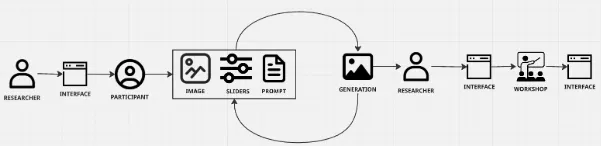
This paper reviews twenty-two recent studies on the use of Text-to-Image Generative AI in Co-design contexts. Participants across diverse backgrounds consistently found text-to-image tools useful for articulating ideas, expanding creative agency, and fostering emotional engagement. However, persistent usability barriers and the resistance of professional creatives highlight critical limitations. The paper proposes a structured model for text-to-image-enabled Co-design Workshops based on best practices of preparing, creating, and reflecting. To realize the full potential of text-to-image systems, developers and researchers must prioritize intuitive design, ethical engagement, and inclusive access, ensuring that AI tools serve as empowering partners in creative collaboration. By simplifying interfaces, enabling multimodal input, providing robust training, and designing for inclusion, developers can transform text-to-image tools from complex, facilitator-dependent systems into intuitive, empowering platforms. These improvements will support both independent and collaborative creativity, expanding the relevance and usability of text-to-image technologies across a wide range of users and contexts.
Committee Members:
Elizabeth Sanders (advisor), Matt Lewis, Elizabeth Newton
Keywords:
Co-design, Participatory Design, Text-to-image, Generative AI, Artificial Intelligence