Kahmin Ong joined the Department of Design in 2023 in the Design Research and Development track. Her primary interest lies in designing innovative solutions that promote physical wellness and preventative care. She is deeply motivated by the global shift toward longevity and the growing need for design to contribute meaningfully to sustainable health and well-being. Her work explores how thoughtful design, rooted in empathy, accessibility, and evidence, can empower people to live healthier, more fulfilling lives.
Committee Members:
- Dr. Elizabeth B.N. Sanders, Advisor
- Yvette Shen
- Dr. Carmen DiGiovine PhD, ATP/SMS, RET
Thesis Project Title: Co-Designing Across the Gaps: Visualizing System Complexities and Stakeholder Perspectives in U.S. Wheelchair Service Delivery
Project Description:
The U.S. wheelchair service delivery process (SDP) supports millions of adults who depend on mobility devices, yet it functions within a fragmented network of clinicians, suppliers, manufacturers, insurers, caregivers, and users. The system’s complex interdependencies, shaped by policy, funding, and clinical procedures, hinder timely access and people-centered outcomes. This thesis explores how design-led visualization sheds light on stakeholder experiences within the wheelchair acquisition process and suggests possibilities for improvement within current structures.
A mixed-methods study integrated semi-structured interviews and co-design workshops with wheelchair users, caregivers, clinicians, suppliers, manufacturers, and insurers, followed by the development of an interactive visualization prototype. Co-design workshops employed journey mapping and future-vision activities, informed the prototype’s structure by capturing lived experiences and speculative redesigns. Thematic analysis identified three primary barriers, including communication breakdowns, insurance-approval delays, and extended delivery times, and revealed relational frictions among insurers, clinicians, and suppliers. A subsequent evaluation survey engaged a broader group of stakeholders to assess the perceived accuracy and usefulness of the prototype.
Survey findings indicated moderate overall satisfaction alongside a clear perception gap. Professional stakeholders rated the initial visual prototypes as highly accurate, whereas users and caregivers more often assessed them as only moderately accurate, highlighting the need for more equitable representation of lived experience alongside professional perspectives. Despite these differences, all stakeholder groups identified the same critical barriers, including communication breakdowns, insurance approval delays, extended delivery times which were incorporated into the visualization. These insights informed a revised prototype, which was iteratively updated in direct response to the survey results and incorporated into the final visualization.
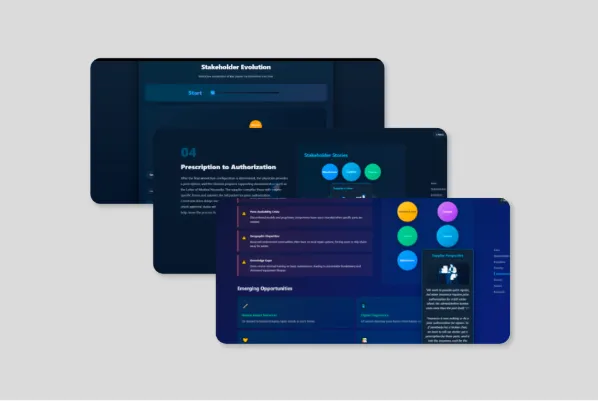
The resulting interactive visualization maps stakeholder influence, friction points, and prospective scenarios such as AI-assisted documentation and integrated digital portals. By making previously hidden processes visible to all stakeholders, the visualization exposes critical tensions between groups, reveals perception gaps about service bottlenecks, and reframes the wheelchair acquisition workflow as lived experience rather than administrative procedure. This shared visibility enables cross-stakeholder dialogue through a common reference point, helping participants understand how individual pain points connect to systemic issues. The visualization informs policy improvement, strengthens communication pathways, and promotes cross-stakeholder collaboration.
Ultimately, the study demonstrates how co-design and systemic visualization can transform bureaucratic processes into shared knowledge, advancing toward a more equitable and efficient wheelchair service delivery system.